


Glass vs Plastic Spice Jars: Which Container Really Keeps Spices Fresh Longer?
Most people don’t realize their spices start losing flavor long before they expire.
Clumping, faded aroma, and dull taste are rarely caused by the spices themselves. In most cases, the problem comes down to how spices are stored. One of the most common questions is whether glass or plastic spice jars actually make a real difference.
In real kitchens—especially warm or humid environments—the choice of container plays a critical role in how long spices retain their aroma, color, and flavor.
By the end of this guide, you will know exactly:
- which container preserves spice flavor best,
- how long spices last in different jars,
- and what to choose for both home and commercial use.

What Actually Ruins Spices Over Time: Air, Moisture, Light, or Heat?
Spices are sensitive ingredients. Their flavor comes from volatile aromatic oils1, which gradually break down when storage conditions are poor.
Among all factors, air and moisture are the most damaging. Air exposure causes oxidation, while moisture leads to clumping and speeds up flavor loss.

Light and heat accelerate these reactions but are usually secondary compared to improper sealing.
If spices lose aroma within a few months or begin to clump together, air exposure is almost always the primary cause. Effective spice storage starts with controlling air and humidity.
Are Glass Jars Better Than Plastic Containers for Storing Spices?
Glass jars are widely preferred for spice storage because they create a stable, non-reactive environment. When paired with proper lids, glass jars form a reliable airtight seal that limits air exchange.
Plastic containers, however, often contain micro-pores2 that slowly allow air and moisture3 to pass through. Over time, this results in faster aroma loss and inconsistent spice quality.

In everyday kitchen use, this difference becomes noticeable within months rather than years. This is also why many food brands and kitchens choose dedicated glass jars and containers for long-term spice storage.
Glass vs Plastic Spice Jars: Side-by-Side Comparison
| Factor | Glass Spice Jars | Plastic Spice Containers |
|---|---|---|
| Airtight sealing | Excellent, stable over time | Often inconsistent due to micro-pores |
| Moisture resistance | Strong barrier against humidity | Weaker moisture protection |
| Odor absorption | Does not absorb odors | Can retain previous spice smells |
| Chemical interaction | Inert and non-reactive | May interact with volatile oils |
| Flavor retention | Preserves aroma longer | Flavor degrades faster |
| Safety | BPA-free4, food-safe | May degrade with heat or age |
| Durability | Long-lasting and reusable | Prone to wear and warping |
| Best use case | Long-term spice storage | Short-term or low-aroma spices |
Which Spice Jar Size Should You Choose? (1 oz, 2 oz, 4 oz, 8 oz Explained)
Choosing the correct jar size helps balance freshness and usability.

| Jar Size | Best For | Typical Use Scenarios |
|---|---|---|
| 1 oz (30 ml) | Rare or expensive spices | Saffron, nutmeg, specialty blends |
| 2 oz (60 ml) | Moderate-use spices | Chili flakes, mixed seasonings |
| 4 oz (120 ml) | Everyday cooking spices | Cumin, coriander, pepper |
| 8 oz (240 ml) | High-usage spices | Paprika, salt blends, BBQ rubs |
Choosing the right jar size reduces unnecessary air exposure and helps spices retain flavor longer.
Spices in Glass Jars: Why Material Matters
Spices stored in glass jars benefit from a non-porous, stable environment that protects aroma and flavor. Compared to spices kept in plastic containers, spices in glass jars are less affected by moisture, air exposure, and odor transfer. This is why glass spice containers are widely used in both home kitchens and professional food environments.

Do Spice Jar Lids Matter? Shaker vs Screw Cap vs Bamboo Lids
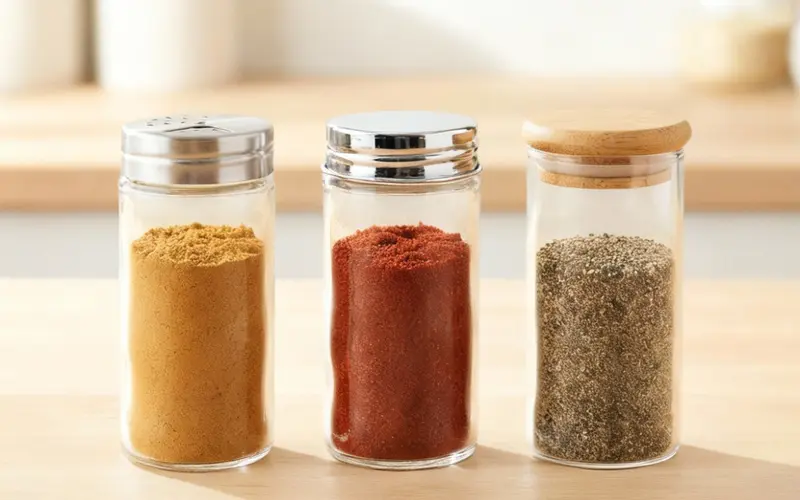
Yes—lid design plays a critical role in how long spices retain their flavor and aroma.
Shaker lids are convenient for daily cooking, but they allow repeated air exposure each time spices are dispensed. Over time, this accelerates oxidation and aroma loss, especially for finely ground spices.
Screw caps provide the most reliable airtight seal5. By minimizing air exchange, they help preserve volatile oils and are the preferred option for long-term spice storage6 in both home kitchens and professional environments.
Bamboo lids are popular for their natural appearance, but sealing performance depends heavily on the internal liner. Without a proper gasket, bamboo lids may allow gradual moisture and air penetration.
For maximum freshness, airtight screw-cap lids consistently outperform shaker and decorative lid options.
How Do Restaurants and Brands Store Spices in Bulk?
Restaurants and spice brands typically store spices in bulk to maintain consistency and reduce cost.

Glass containers are favored because they protect against moisture and air while allowing visual inspection. Wide-mouth designs with secure lids are common in high-turnover kitchens where efficiency matters.
Expert Verdict: Glass or Plastic for Spice Storage?
- For long-term storage, glass jars consistently outperform plastic in flavor retention.
- Airtight sealing matters more than jar shape or appearance.
- Matching jar size to usage frequency reduces unnecessary air exposure.
- Plastic containers may work short term, but are unreliable for preserving quality.
If spice quality matters, glass is the safer long-term choice.
Conclusion
From a food-quality perspective, glass jars provide a more stable storage environment for spices.
Their resistance to air, moisture, and chemical interaction7 helps preserve flavor far longer than plastic containers. For both home kitchens and commercial use, glass remains the preferred choice when long-term spice quality matters.
👤 About the Author
This article was written by a packaging specialist experienced in glass spice jars, food storage containers, and custom packaging for food brands.
The author has worked closely with manufacturers, wholesalers, and commercial kitchens to evaluate how different container materials impact moisture control, aroma retention, and long-term spice quality.
Glass Spice Jars for Bulk Supply and Private Label Brands
For businesses that require consistent quality, food-safe materials, and scalable production, glass spice jars remain the preferred packaging choice.
Businesses planning bulk sourcing or custom glass spice jar solutions often benefit from discussing specifications early.
You can learn more about custom options on our custom glass packaging page.
Frequently Asked Questions (People Also Ask)
Are glass spice jars better than plastic for storing spices?
Yes. Glass spice jars provide better protection against air and moisture3, remain chemically inert, and preserve aroma longer than plastic containers.
How long do spices last in glass jars?
When stored in airtight glass jars away from heat and light, most ground spices retain usable flavor for 18–24 months.
What is the best container for storing spices long term?
The best container is an airtight glass jar with a secure screw cap, stored in a cool, dark place.
Learn about the role of volatile aromatic oils in spices and how they impact flavor retention. ↩
Understanding micro-pores can help you choose the right container for spice storage. ↩
Discover how air and moisture contribute to spice degradation and how to mitigate their effects. ↩
Understanding BPA-free materials is essential for safe food storage; learn more about it. ↩
An airtight seal is crucial for preserving spice quality; find out why it matters. ↩
Learn effective strategies for long-term spice storage to maintain flavor and aroma. ↩
Understanding chemical interactions can help you select the best containers for spices. ↩


