Quick Answer: Can an AI Bottle Design Be Manufactured?
Quick answer:
In many cases, yes—but an AI image alone cannot prove that the exact design is manufacturable. It can show the intended silhouette, proportions, color, surface style, and brand direction.
A glass manufacturer still needs practical information such as target capacity and market, key dimensions, neck finish and closure, decoration area, expected quantity, and how the bottle will be used.
The concept must then be translated into technical drawings or a 3D model and reviewed for manufacturability. If the original shape is not workable, revise the affected features or proportions before choosing a suitable stock bottle, a stock bottle with custom decoration, or a new custom mold.
AI image tools are useful for comparing silhouettes, proportions, colors, and decoration ideas before engineering begins. The problem starts when a convincing visual is treated as a manufacturing file: it may hide impossible geometry, an unsuitable neck, an unstable base, or the wrong usable volume. The practical question is therefore what must be defined and checked before the concept can become a reliable glass package.
What an AI Bottle Image Shows—and What It Does Not
An AI image is best used as a visual brief. It can communicate the intended silhouette, proportions, color, surface style, and brand direction.
However, it does not prove how the bottle will release from a mold, distribute glass, stand on a production line, or work with the selected closure and filling process.
| The image may show | Manufacturing still needs |
|---|---|
| Overall silhouette and proportions | Confirmed capacity and fill level |
| Shoulder, body, and base style | Critical dimensions and tolerances |
| Color and surface appearance | Glass distribution and structural feasibility |
| Embossing or decoration direction | Decoration area and process limits |
| Suggested closure appearance | Standard neck finish and closure compatibility |
| Brand mood and shelf presence | Target market, use conditions, and expected quantity |
Two bottles can look similar in a rendering while requiring different neck finishes, mold construction, glass weights, or decoration methods. If the concept depends mainly on graphics or surface finish, a stock bottle with custom decoration may preserve the intended look. If it depends on a distinctive shoulder, offset body, sculpted base, or relief, the supplier needs enough geometry to judge mold release, glass distribution, stability, and usable volume before recommending a stock-based solution or a new custom mold.
Before sending the image, mark its features in three groups:
- Must keep: the features that carry the product or brand idea and cannot be removed without changing the concept.
- Can change: proportions, radii, relief depth, base treatment, or other details that may be adjusted to improve feasibility.
- Open for recommendation: unresolved items such as exact neck finish, dimensions, or decoration process for which you want the supplier’s recommendation.
This prevents the supplier from protecting a minor detail while changing the feature the buyer considered essential.

What Information a Glass Manufacturer Needs Before Engineering Review
You do not need to solve every technical detail before contacting a supplier, but the engineering team should not have to guess the project basics. At minimum, identify the product and use, target capacity and market, approximate size limits, closure direction, decoration needs, expected quantity, reference material, and any known filling or packing constraints. The final checklist below provides the complete first-submission list. If a detail is genuinely undecided, mark it as open for recommendation rather than inserting a guessed specification.
How Manufacturers Check Whether the Design Is Feasible
A manufacturability review converts the appearance of the concept into questions about forming, glass distribution, closure, filling, decoration, packing, and use. The exact answer depends on the project. A useful review should not merely say that the image is "possible" or "difficult"; it should identify the feature being checked, explain why it matters, show what may need to change, and point to the next decision or validation step.
Where will the mold divide, and can the bottle be released?
Deep undercuts, abrupt steps, extreme recesses, and some wraparound forms can obstruct mold division or release. A hidden rear view may also conflict with the apparent front geometry. The supplier may recommend a shallower recess, smoother transition, or moving a feature to a label, coating, or closure. The buyer should identify whether the relief or silhouette is must keep and ask which surfaces affect release; the answer helps determine whether stock packaging, decoration, or a custom mold is appropriate.
If this question is left unresolved, the team may approve a visual direction that later needs a major structural change. Ask the supplier to mark the surfaces that create the conflict and show which adjustment preserves the original design intent.
Are the geometry and left-right views internally consistent?
Generated images often optimize one attractive angle rather than a complete object. The shoulder, heel, or embossing may not align across views. Provide additional views where possible and state which view controls the design. The supplier should list contradictions instead of inventing hidden geometry; they must be resolved in the drawing or 3D-model stage before a physical prototype can represent the intended bottle.
This avoids paying to review or prototype a shape that different team members understand differently. The output should be one agreed geometry, not several attractive but incompatible views.
Can the glass be distributed through the shape?
Sharp corners, narrow transitions, deep relief, and abrupt changes in mass can make glass distribution harder to evaluate and control. A heavy-base look also changes internal geometry and usable capacity. Engineers may soften a corner, reduce relief, rebalance the base, or adjust proportions. The buyer should identify the essential visual mass and ask which areas require geometry changes before tooling or sampling.
An AI image cannot prove wall thickness or glass distribution. Drawing or 3D-model review can identify high-risk geometry, but the physical result must be checked at the applicable glass-sample and approval stages.
The supplier’s response should separate what can be judged from geometry from what still needs physical evidence. This prevents a rendering or visual prototype from being treated as proof of the resulting glass bottle.
Will the bottom contact and body remain stable in use?
An AI image cannot prove the bottle’s contact area, center of mass, or stability in motion. Standing on a table is not the same as passing reliably through conveying, filling, closure application, and packing. Review the base together with overall proportions, capacity, glass distribution, and known line and carton constraints. The supplier should state whether the form can be retained, what must change, and which physical or line-compatibility validation should follow. If stability requires major silhouette changes, check whether a similar stock bottle can meet the requirements. If the base defines the concept, it may still be retained, but its proportions may need engineering revision before tooling.
For the buyer, the commercial consequence is to separate design revision from route selection. First resolve whether the special base and proportions can work; then choose the final route—stock bottle, stock bottle with custom decoration, or new custom mold. Make that decision before visual approval hardens into an expensive expectation.
In MISA’s experience, some AI concepts use an inverted taper that leaves too little support at the bottom for the bottle to stand or move reliably in the intended operation. When the taper-to-base relationship creates that problem, the overall silhouette may need to be revised rather than patched at one small point.
This does not mean every inverted-taper bottle is unmanufacturable; the decision depends on its proportions, bottom support, capacity, glass distribution, and handling conditions. Illustrative example: if a concept narrows dramatically toward a small base, the next revision may preserve the visual direction while changing the overall contour and bottom support. This is a decision pattern, not a customer case.
Do the neck and closure constrain capacity, sealing, and filling?
The neck must suit the closure, filling, and sealing method. Because it shares the bottle’s overall height and internal volume, a late finish change can affect capacity, shoulder proportions, filling clearance, and closure application. A rendered cork, cap, or pump does not define the finish underneath it. Provide the closure direction or a reference closure, then ask the supplier to identify the compatible neck, required revisions, and effect on the final route.
If the exact finish is still open, say so. The useful first response is not a guessed finish but a list of compatible directions and the information needed to choose between them.
Can the bottle be filled, conveyed, decorated, and packed?
Filling, closure application, conveyors, decoration, and secondary packaging all impose contact and space requirements. Strong curves, ribs, deep embossing, and rapid diameter changes can reduce usable decoration area or complicate handling. Disclose known restrictions and ask which dimensions must be checked against filling or packing equipment, which surfaces remain usable, and what still requires physical validation. For example, a deep recessed label panel marked must keep may need to become shallower so the bottle can release and still provide a usable label surface.
The supplier should return the affected feature, the likely operational consequence, and the next check. That gives the buyer something testable instead of a general statement that the concept is feasible.
Revise the Concept First, Then Choose the Implementation Route
Manufacturability review and route selection answer different questions. First, determine whether the original AI concept can be retained. If the shape creates molding, glass-distribution, stability, closure, decoration, or handling problems, revise the affected features or the overall silhouette before selecting the final implementation route.
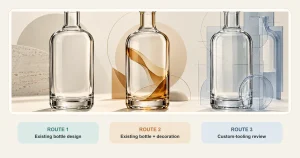
Revising the concept does not mean an existing production mold can be modified easily. It means the design intent is being translated into workable geometry. After that review, the project has three practical implementation routes:
| Route | Best when | Main limitation / what to check |
|---|---|---|
| Stock bottle | The overall shape is flexible, or the project is testing the market with lower development complexity. | The silhouette is not exclusive; confirm capacity, market, neck finish, and availability. |
| Stock bottle with custom decoration | Brand identity comes mainly from color, graphics, surface finish, label, or a branded closure. | Confirm that the selected bottle has a suitable decoration area and supports the intended process. |
| Custom mold | The three-dimensional silhouette is central to brand recognition or stock options cannot meet the functional requirements. | Requires clear specifications, manufacturability review, tooling, sampling, and approval. |
The decision should protect the part of the concept that creates value. If the distinctive feature is a surface effect, decoration may be enough. If it is the bottle’s three-dimensional profile, a custom mold may be necessary. In either case, required geometry revisions happen before or during engineering definition; they are not a separate fourth implementation route.
Ask the supplier to explain the tradeoff in buyer terms: which visual feature is preserved, which development work is avoided or added, and what evidence is required before the route can be approved. This makes the comparison useful even when more than one route is technically possible.
From AI Concept to a Production-Ready Glass Bottle
The path is iterative rather than automatic. Each validation level answers a different question, so approval should not move further than the evidence supports.

- Define the brief. Select the preferred image, mark must keep / can change / open for recommendation, and provide the product, capacity, market, closure, decoration, approximate dimensions, and quantity range.
- Translate the concept. Use a technical drawing or 3D model to define geometry, expose contradictory views, and support the engineering checks described above.
- Review feasibility and revise where needed. Record what can remain, what must change, and why; this is not permission to alter an existing production mold.
- Select the final route. Choose a suitable stock bottle, stock bottle with custom decoration, or a new custom mold after the feasibility decision.
- Confirm the revised shape. After a structural change, MISA normally uses a 3D video to help the customer confirm the overall visible form. If hands-on review of scale, grip, proportions, or presentation is needed, a physical 3D sample can be requested; it is often unnecessary for a simple structure and is not a glass trial bottle.
- Review the applicable glass trial. When the route reaches tooling and sampling, a glass sample supports checks of appearance, closure direction, decoration area, handling, and packing assumptions. One sample does not establish repeatable mass-production performance.
- Complete pre-production approval. Resolve open bottle, closure, decoration, filling, and packing requirements using the evidence required for the project.
Each validation level answers a different question: an image shows direction; drawings and 3D models define geometry; a 3D video helps confirm visible form; a physical 3D sample supports hands-on review of scale, grip, proportions, or presentation; glass trials and production approvals address later physical and manufacturing questions. None of these steps implies free sampling, a fixed schedule, a standard sample format, or guaranteed production performance.
The validation path also depends on the selected route. A stock bottle needs capacity, neck-and-closure, availability, and packing checks. A stock bottle with custom decoration also needs confirmation of the decoration process and finish. A new custom mold requires engineering and tooling review, an applicable glass sample, and pre-production approval.
At every step, record the decision being made and the evidence still missing. This keeps a visual approval from silently becoming an engineering, tooling, or production approval.
Common Mistakes That Delay an AI-to-Bottle Project
- Sending one image with no priorities. Mark important features as must keep, can change, or open for recommendation, and identify which view controls the design.
- Confirming critical specifications too late. Capacity, market, closure, decoration, and packing limits can change the accepted appearance. State them before detailed engineering or mark the decision as open.
- Treating visual approval as manufacturing approval. A similar stock bottle does not prove an old mold can be altered, and an attractive concept may still conflict with release, filling, decoration, or packing. Ask for the recommended route and the next validation step.
Unknown details can remain open, but list them clearly and name who will confirm them.
What to Send for a First Engineering Review
Use this checklist when you are ready to discuss the concept with a glass packaging supplier:
- AI-generated image, sketch, or reference bottle
- Product type and intended use
- Target capacity and sales market
- Preferred height and width, if known
- Closure direction or reference closure
- Label, printing, coating, embossing, or other decoration needs
- Expected order range
- Features that must remain unchanged
- Features marked can change or open for recommendation
- Known filling, conveying, decoration, carton, or shelf constraints
This does not need to be a complete engineering package before the first useful review. Ask the supplier to cover four points in the first response:
- Feasibility conclusion: which features can remain, which may need revision, and what design intent each change should preserve.
- Recommended final route: a suitable stock bottle, a stock bottle with custom decoration, or a new custom mold.
- Missing information: the decisions or files needed before engineering can proceed.
- Next validation step: drawing or 3D-model review, visual prototype, glass sampling, closure/decoration/packing check, or another project-specific approval point.
If you have an AI image, sketch, or reference bottle, send it with the basic project information above. Our custom bottle development support can help identify which parts of the concept may need revision. We can then discuss whether a suitable stock bottle, custom decoration on a stock bottle, or a new custom mold is the appropriate implementation route.
Frequently Asked Questions
Can the same AI bottle concept be used for more than one capacity?
Possibly, but the design should not simply be scaled in every direction. A different capacity can change the internal volume, proportions, label area, bottom treatment, and relationship between the body and neck. Each capacity needs its own geometry review, and the supplier should explain which visual features can remain consistent across the range.
Should I request a visual prototype or a glass sample first?
Use a 3D video when a revised custom shape needs visual review; request a physical 3D sample only if hands-on review of scale, grip, proportions, or presentation is needed. Neither proves glass performance. Then verify the selected route: stock-bottle fit and packing; decoration process and finish for decorated stock; engineering, tooling, glass sampling, and pre-production approval for a new mold.
What if my filling-line or carton constraints are not confirmed yet?
Do not invent them. Mark them as open, identify who will confirm them, and resolve the relevant filling, conveying, or packing assumption before approving geometry that depends on it.